


Program 05 · Educational preview
Reinforcement Learning & Frontier AI Research Engineering
Study how feedback shapes an agent’s decisions.
Learners interested in decision-making and research experiments.
Current curriculum and admission prerequisites are not published in the verified program source. Confirm them with the team.

Free educational reading
Explore this program through articles.
1 published article · Reading times are calculated from the content.
Attention changed how information moves.
Understand the Transformer’s central idea, what the original experiments reported, what they did not establish, and why the architecture still matters to engineers.
Understand the work
One example, step by step.
- Observe the current state
- Choose an action with a policy
- Receive the next state and reward
- Evaluate an episode before changing the policy
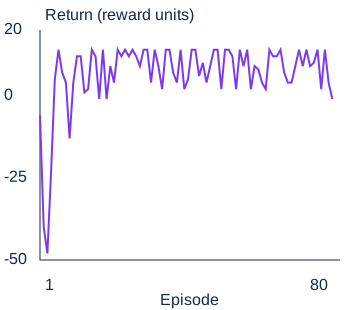
What did the training actually record?
Local tabular Q-learning, 4 × 4 grid, seed 17, 80 episodes, up to 40 steps each. Learning rate 0.5; discount 0.9; exploration probability 0.25. Reward: −1 per move, −4 extra for collision, +20 extra at the goal. Terminal goal has no bootstrapped value.
Read all recorded returns
1: -6; 2: -40; 3: -48; 4: -23; 5: 5; 6: 14; 7: 7; 8: 4; 9: -13; 10: 4; 11: 12; 12: 12; 13: 1; 14: 2; 15: 14; 16: 12; 17: -1; 18: 14; 19: -1; 20: 9; 21: 4; 22: 14; 23: 12; 24: 14; 25: 12; 26: 14; 27: 12; 28: 9; 29: 14; 30: 14; 31: 4; 32: 14; 33: 9; 34: 2; 35: 14; 36: 14; 37: 7; 38: 4; 39: 14; 40: 2; 41: 5; 42: 14; 43: 14; 44: 6; 45: 10; 46: 4; 47: 9; 48: 14; 49: 14; 50: 2; 51: 14; 52: 14; 53: 12; 54: 2; 55: 14; 56: 9; 57: 14; 58: 2; 59: 9; 60: 8; 61: 4; 62: 2; 63: 14; 64: 12; 65: 12; 66: 14; 67: 7; 68: 4; 69: 4; 70: 9; 71: 14; 72: 9; 73: 14; 74: 9; 75: 10; 76: 14; 77: 2; 78: 14; 79: 4; 80: -1
The graph is generated by the same seeded learning model in the source. Its exploration decisions can make later episodes worse; a smooth rising curve would hide that behavior.
With −1 per move and +20 at the goal, a six-move route returns 14. Finishing sooner avoids extra movement penalties.
Violet · learner · Amber · reward · Teal · goal / route
Fixed replay: 9 moves, 1 collisions, reward 7. Goal reached. The amber indicator shows reward under the same rules for both policies.
How it works
Fixed illustrative policies, not live training. Both use the same rules: −1 per move, −4 extra for a collision and +20 for reaching the goal.
Article draft · Awaiting editorial publication
How Reinforcement Learning Turns Feedback into Better Decisions.
An agent in a small grid must choose between moving toward a destination and exploring an unfamiliar direction. It receives feedback after each action. Reinforcement learning studies how such interaction can shape a policy: a rule for choosing actions.
Define the environment before discussing learning
In this example, state is the agent’s cell. Available actions are right, up, left and down. A blocked move leaves the agent in place. An episode ends at the destination or after forty steps. Each move costs one reward unit; a collision costs four extra units; reaching the goal adds twenty.
An observation is what the agent is given about the environment. Here it sees the full state, but other environments may provide incomplete information. A reward is numerical feedback, not a statement that the action was ethically or practically correct. The policy determines which action to select.
Gymnasium’s basic usage documentation demonstrates the separation between reset, actions, observations, rewards and episode termination. Our exercise uses the same conceptual separation without requiring Gymnasium.
Receiving feedback is not the same as updating a policy
The browser graph runs actual tabular Q-learning with seed 17. It updates an action-value estimate toward the observed reward plus a discounted estimate of future value. The learning rate controls the update size; the discount controls the contribution of future reward. At the terminal goal, there is no future value to bootstrap.
Exploration chooses a random action with probability 0.25; otherwise the agent selects its highest current estimate. It can therefore make a worse choice even after finding a useful route. The recorded eighty episode returns fluctuate. The graph shows generated records, not an attractive invented learning curve.
The Sutton and Barto textbook develops action values, exploration and temporal-difference learning in detail. This tiny fully observed grid is much simpler than language-model post-training or a research-scale environment.
A poorly chosen reward can reward the wrong behavior
Switch the reward example to “reward every step.” A fixed forty-step loop earns forty units, while a six-step completion earns eleven under the alternate rule. That objective rewards delay. These comparisons are calculated rollouts of specified policies; switching the button does not train another agent.
Exercise: reproduce and challenge the result
Run the downloadable CPU-only Python Q-learning example. It uses the same linear-congruential random-number generator and settings as the browser, so seed 17 should reproduce the same eighty returns. Change only the seed, retain the settings, and compare returns without selecting only the most favorable run.
Next change the reward rule and write down the behavior you want before examining the recorded outcome. Report episode caps, collisions, termination and whether the agent reached the goal. A higher return can reflect the reward design rather than a better solution to your intended task.
Build a reproducible experiment with explicit settings, policy comparisons and limitations. Learn probability, programming and experimentation foundations as needed; ask the program team for its current prerequisites rather than treating this exercise as an admission standard.
Download the editable graph SVG ↓
Project example
Build evidence of your understanding.
A reproducible policy comparison with an explicit reward rule.
Keep the inputs, assumptions, source references, expected behavior, observed results and limitations together. This is an educational project suggestion, not a verified course deliverable.